
Storm Damage
Signs You Need a New Roof in DFW: 10 Things to Check After a Storm
Ten specific things to inspect on your roof after a Dallas–Fort Worth storm — what they mean, what to do about each one, and when to call a professional.
Key Takeaways
- After any DFW storm, walk your property and check 10 specific things — most can be inspected from the ground in 15 minutes.
- The most reliable damage indicators aren't on the roof itself — they're on your gutters, downspouts, AC fins, and window screens.
- If you see three or more of these signs together, schedule a free professional inspection within the week.
- Some signs (sagging, daylight in the attic, active leaks) mean call today, not "next week."
- Don't climb on the roof yourself — wet shingles after a storm are dangerous, and you can do more damage to compromised areas by walking on them.
After a DFW hailstorm, you can usually tell within fifteen minutes whether your roof needs a closer look. Most of the signs are visible from the ground.
I’ve inspected hundreds of DFW roofs over the years, and a few patterns come up over and over. Below is the same checklist I run mentally when I pull up to a job after a storm.
Walk your property. Check these ten things in order.
1. Dents on your gutters, downspouts, and AC fins
This is the single most reliable indicator of recent hail damage — and you don’t need to climb anything to see it.
Hail that’s big enough to dent metal is big enough to bruise asphalt shingles. If your aluminum gutters have fresh dents, your downspouts look “pocked,” or your AC condenser’s metal fins are flattened in spots, you almost certainly have shingle damage too.
Look at the tops of your gutters (the half-round edge) for crisp circular dents. Look at the sides of downspouts for impact marks. Look at the AC unit’s metal fins for crushed/flattened areas.
If you see any of those, you should schedule a roof inspection — even if your shingles look fine from the ground.
2. Shingle granules in your gutters and at the base of downspouts
Run your hand along the bottom of a downspout. If your palm comes back coated in sandy black granules, that’s your roof shedding faster than it should.
Some granule loss is normal — especially with newer roofs (the first six months of life always lose loose granules). But large clumps of granules washing out after a storm means hail impacts dislodged them. The shingle underneath becomes exposed to UV and the next round of weather, and the deterioration accelerates from there.
What to look for: dark grit collecting in driveway corners, on top of patio furniture, or piled up where your downspouts empty out.
3. Missing or displaced shingles
Wind damage shows up as obvious gaps. Walk around your house and look up at the roof from each corner.
- Completely missing shingles — leave white or tan patches where the underlayment shows through
- Lifted shingles — corners curled up or pulled away from the rest of the row
- Out-of-place shingles — shifted out of their normal staggered pattern
Even one or two missing shingles after a storm is a problem. They create entry points for the next round of rain, and the gaps almost always grow if not addressed quickly.
4. Visible hail bruises on shingles
This one’s harder to see from the ground unless damage is severe. But sometimes you can spot it.
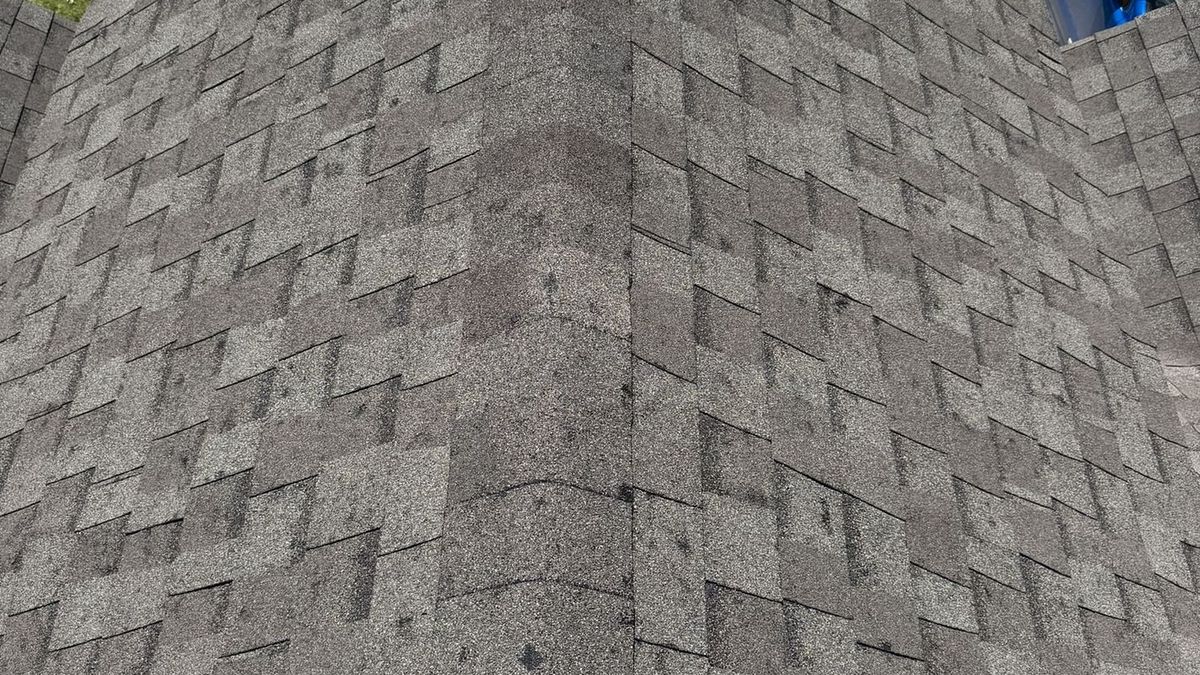
Bruised shingles look like dark circular spots where the granules have been knocked off, exposing the asphalt mat underneath. From the ground they look like darker patches scattered across the roof. After hail events, I sometimes notice these from the street while driving by neighborhoods.
If you have binoculars, scan the side of the roof facing the storm. Bruises are usually more concentrated on one side of the house depending on the wind direction during the storm.
5. Damaged flashing around chimneys, skylights, and vents
The metal flashing around penetrations (chimneys, skylights, plumbing vents, exhaust vents) is one of the first things to fail after hail or wind.
Look for:
- Bent or dented metal around the chimney base
- Loose or popped-up flashing that’s no longer sealed
- Cracked caulk or sealant around vents and pipes
- Visible gaps where flashing meets shingles
Flashing failures cause leaks long before the rest of the roof shows symptoms. If you only have flashing damage and the rest of the roof is fine, you may need a repair instead of a full replacement.
Spotting any of these from the ground? Get a free roof inspection.
We climb the roof, document every issue with photos, and give you a written report — whether or not you need work done. Free across the DFW metroplex.
Schedule a Free Inspection →6. Daylight visible in your attic
Climb into the attic during the day and look up at the underside of the roof deck. If you see pinpricks of daylight coming through, water is getting through too.
A small amount of light around vents and the ridge is normal — those are designed openings. But scattered points of light across the deck, especially in valleys or near penetrations, are signs of physical damage to the shingles or underlayment above.
While you’re up there, look for:
- Dark water stains on rafters or decking (sign of past or active leaks)
- Damp insulation (active leak, this storm or a recent one)
- Mold or mildew smell (long-term moisture problem)
7. Water stains on ceilings or walls inside the house
If you see new water stains on your ceiling or where the ceiling meets the wall, water is already inside the building envelope. Don’t wait on this one.
Common stain locations:
- Around the chimney chase (chimney flashing failure)
- Where ceiling meets exterior wall (gutter overflow, fascia rot, or shingles too short at the eave)
- Around bathroom or kitchen vent fans (vent flashing failure)
- Hallway ceilings (often happens near attic accesses if there’s a leak directly above)
The stain may show up a few days to a few weeks after the storm — water travels through insulation before showing up on drywall.
8. Sagging roof line or visible dips
Stand across the street and look at your roof’s ridge line and slopes. They should be straight. Any visible sag, dip, or wave is a structural concern.
Sagging usually means decking damage underneath — either from long-term moisture or from a recent impact (a fallen tree limb, for example). This is one of the few signs on this list that means “call today, not next week.” Structural issues can escalate quickly, especially with another storm in the forecast.
9. Shingles that are curling, cupping, or buckling
Even without a recent storm, certain shingle behaviors mean your roof is at the end of its useful life:
- Curling — corners of shingles turning upward (typically a sign of age + UV exposure)
- Cupping — middle of the shingle rising, edges staying flat (often heat-related)
- Buckling — wavy or rippled appearance across rows of shingles
After a storm, these existing weaknesses get worse. A roof with widespread curling or buckling is usually past replacement age (15+ years) and should be assessed by a professional even if no specific storm damage is visible.
10. Mold, algae streaks, or moss growth
Dark streaks running down your roof (especially the north-facing slopes) are usually algae. Green fuzzy patches are moss. Both indicate moisture sitting on the roof longer than it should — usually because the shingles’ granule layer has worn down and lost its water-shedding capacity.
After a storm, algae and moss tell you the roof was already showing wear. The storm may have accelerated existing problems.
These on their own aren’t always a “replace the roof” issue — sometimes they can be cleaned. But combined with other signs from this list, they tell you the roof is in its last years.
Just had a hailstorm? Don't wait on it.
The longer you wait after a storm, the harder insurance claims become. Free inspection, written photo report, no obligation either way — we'll tell you honestly whether you need a roof or just a watchful eye.
See our storm damage process →When to act vs. when to wait
Use this as a rough decision guide:
| Signs you see | What to do |
|---|---|
| Daylight in attic, active leak, sagging roof line | Call a roofer today. This isn’t a “next week” situation. |
| 3+ signs from the list above, after a recent storm | Schedule a free inspection within the week. Insurance claim window matters. |
| 1–2 minor signs, no recent storm | Schedule an inspection within the month. Get documentation, even if no work is needed yet. |
| None of the above, roof is over 15 years old | Annual inspection. Most DFW asphalt roofs last 18–25 years; getting baseline documentation each year catches issues early. |
Frequently asked questions
Can I file an insurance claim if I only see ground-level damage like dented gutters?
Yes. Dented metal is one of the clearest indicators that hail was large enough to damage shingles too. An adjuster will still need to inspect the roof, but ground-level metal damage is often the trigger that prompts a claim. Get a roofer to inspect first so you know what’s there before you call your insurer.
My neighbor got a new roof but mine looks fine. Should I still get an inspection?
Yes — especially if your homes are similar age. Storm patterns aren’t perfectly uniform across a neighborhood, but if one home took enough damage to warrant replacement, others nearby probably have at least some damage. Free inspections cost nothing, and the photo report is yours to keep.
How old is “too old” for a Texas asphalt roof?
Standard 3-tab asphalt shingles last 15–20 years in Texas. Architectural (dimensional) shingles last 20–30 years. Premium impact-resistant shingles can go 30+ years. Texas heat shortens these ranges by a few years compared to milder climates. If you don’t know your roof’s age, check your home inspection report or ask a roofer for an estimate based on shingle wear.
What if I’m not sure whether I see “real” damage or just normal wear?
That’s exactly what a free inspection is for. We’ll tell you honestly. The most useful thing a professional roofer can do is give you a written photo report showing what’s normal wear vs. what’s actual damage — even when no work is needed. Documentation now saves you headaches later.
I see one of the signs but I’m not ready to file a claim. What should I do?
Document it anyway. Photograph what you see, note the date, and save it. If you decide to file later (or if a future storm makes things worse), you’ll have a timeline of when problems started. Insurance adjusters look favorably on documented histories.
A final note
You don’t need to know the difference between Class 3 and Class 4 shingles. You don’t need to know what underlayment your roof has. You just need to know what to look for from the ground, and when those signs add up to enough that a professional should take a look.
If you’ve spotted three or more of these signs — or any of the urgent ones (active leak, daylight in the attic, sagging line) — schedule a free inspection. We come out, climb the roof, document everything, and tell you straight what you’re looking at. The written photo report is yours to keep whether you end up needing work or not.