
Insurance Claims
What Insurance Adjusters Look For When Inspecting Hail Damage
An inside look at how insurance adjusters evaluate hail damage on a roof — what they check, what they miss, and how to make sure your claim is fully documented.
Key Takeaways
- Insurance adjusters use a standardized "test square" method — counting hail impacts in a 10×10 ft area to determine if the slope qualifies for replacement.
- Most adjusters need 8+ functional hits per test square to call a slope damaged. Anything less and they call it "cosmetic."
- Adjusters routinely miss damage in valleys, around penetrations, on ridge caps, and on metal flashing — these aren't part of the test square calculation.
- The single most important step you can take: have your roofing contractor on the roof at the same time as the adjuster.
- You can challenge an adjuster's determination by filing a supplemental claim with additional documentation.
I’ve watched a lot of insurance adjusters inspect roofs over the years. The good ones are thorough and fair. The rushed ones miss things. All of them follow roughly the same playbook — and if you understand that playbook, you have a much better shot at a fair claim outcome.
Here’s what they’re actually looking for, in the order they check.
The “test square” method
Most adjusters use a standardized approach called the test square: they mark off a 10-foot by 10-foot area on each major slope of your roof and count the number of “functional” hail impacts inside it.
A “functional” hit is one that breaks the seal of the shingle and exposes the asphalt mat — not just a surface scuff. They distinguish between functional damage (must be replaced) and cosmetic damage (looks bad but doesn’t compromise the shingle’s lifespan).
The standard threshold most insurers use:
| Functional hits per test square | Determination |
|---|---|
| 0–4 | Slope is undamaged, no claim |
| 5–7 | Borderline, sometimes negotiable |
| 8+ | Slope qualifies for replacement |
So if your roof has 6 hits per square on the south slope and 9 hits per square on the east slope, the adjuster might write up the east slope for replacement and leave the south slope alone — even though your whole roof was hit by the same storm.
What they check on each slope
Inside each test square, adjusters look for:
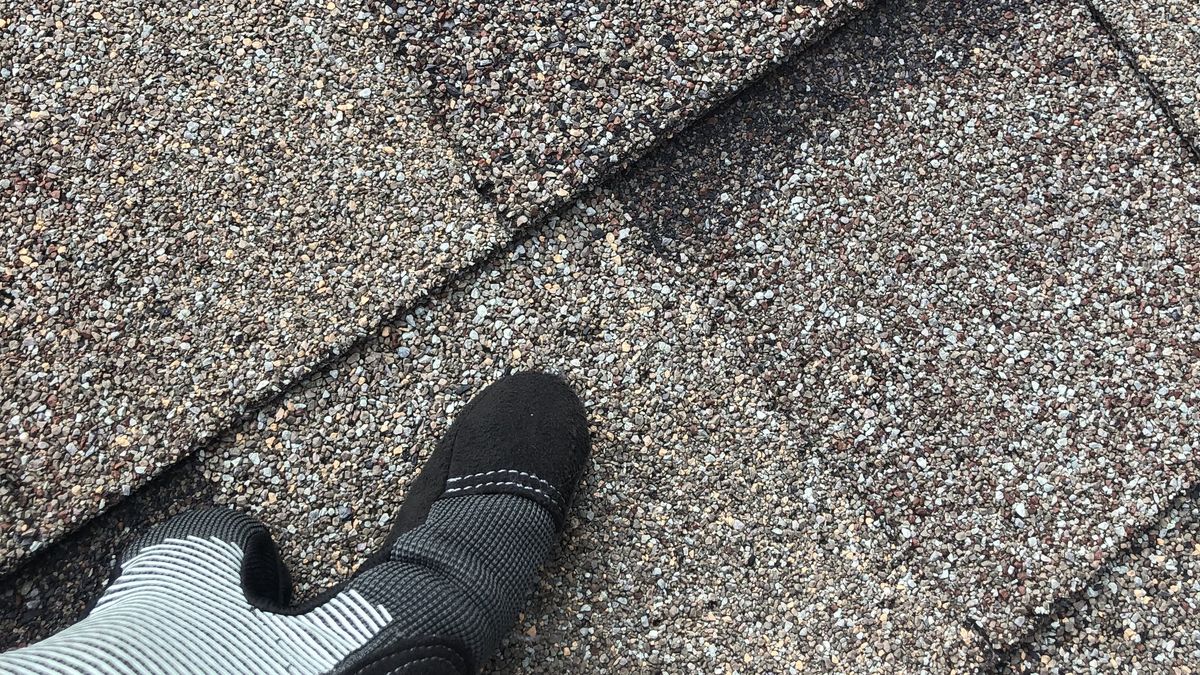
Impact bruises with broken granules The most common functional damage. Dark circular spots where granules have been knocked off, exposing the mat. They press on each suspected bruise with a thumb to check if the mat is fractured underneath.
Cracked or split shingles Larger hail can split shingles along their length. These are always considered functional.
Granule loss patterns Loose granules accumulating in valleys and at downspouts confirm impact. Some adjusters bring a magnifying glass to look at granule density.
Test square location The test square is supposed to be on the most-damaged part of the slope — but rushed adjusters sometimes mark it off in a clearly undamaged area to make the count come up short. Watch for this. A test square in the middle of a clearly clean section misrepresents the slope’s actual condition.
What they routinely miss
This is where having a roofer at the inspection matters most. Adjusters often miss or undercount:
Damage in valleys Valleys are where two roof slopes meet. They’re harder to walk safely, so some adjusters skip them. But valleys often have concentrated damage because of the angle of impact and the metal flashing underneath.
Hail strikes on metal flashing Adjusters focus on shingles. They sometimes ignore dented chimney flashing, vent flashing, and drip edge — all of which need replacement after a hail event.
Ridge cap damage The shingles along the very top of the roof (ridge caps) often take more impacts than field shingles because of their elevated angle. Some adjusters don’t count ridge cap damage against the slope total.
Pipe boot and vent damage Rubber pipe boots can be punctured by hail. Metal exhaust vents can be flattened. Both create immediate leak risks and aren’t part of the test square calculation — they need to be added separately.
Collateral damage to gutters and downspouts If hail dented your gutters, the gutters need replacement too. This is often a separate line item and sometimes gets missed entirely.
Damage to skylights Hail can crack skylight glass or damage flashing. Adjusters who aren’t specifically looking for it often miss this.
Have an adjuster visit coming up?
We meet adjusters on the roof free of charge for any homeowner who hires us for the work if the claim is approved. No catch — it's just how we get the best outcomes for our customers.
See our claim process →How they document what they find
Adjusters use a software tool called Xactimate to write up scopes and pricing. It calculates costs based on regional labor and material rates updated quarterly.
The scope includes:
- Tear-off of damaged materials
- New materials (shingles, underlayment, flashing, etc.)
- Labor at regional rates
- Disposal fees
- Code-required upgrades
Your insurance settlement is based on this Xactimate write-up. If items are missing, your settlement is short.
Why a contractor’s documentation matters
When your roofing contractor inspects the roof before the adjuster, they document everything they find with photos and notes. They give you a written report.
When the adjuster arrives, they compare what the adjuster sees vs. what your contractor documented. If the adjuster missed something, the contractor points it out on the roof, in real-time.
This is how full-replacement determinations happen. Without a contractor’s documentation, you’re trusting that the adjuster found everything — and a rushed adjuster on a complex roof rarely does.
Filing a supplemental claim
If the adjuster’s initial scope is too small, you can file a supplemental claim — additional damage your contractor documents after the original inspection. This is extremely common after major hail events.
How it works:
- Your roofing contractor takes additional photos of damage missed by the adjuster
- Contractor writes up a supplement with the additional scope and Xactimate-equivalent pricing
- You (or your contractor on your behalf) submit the supplement to your insurance company
- Insurance reviews and typically approves additional payment
Supplemental claims aren’t automatic — they require documentation. But they routinely add $1,000 to $5,000+ to claim payouts when the initial scope was incomplete.
When adjusters and contractors disagree
Sometimes the adjuster and your contractor see things differently. Common disagreements:
- Cosmetic vs. functional damage — was that hit a bruise or just a surface scuff?
- Number of slopes that qualify — three slopes or four?
- Decking replacement allowance — how many sheets of OSB will be needed?
- Flashing reuse vs. replacement — can existing flashing be reused or does it need to be new?
When you have these disagreements, options:
- Negotiate with the adjuster during the on-site meeting (often resolves it)
- Request a re-inspection by a different adjuster (allowed in Texas)
- File the supplement with additional documentation
- Invoke your policy’s appraisal clause — both parties hire independent appraisers, who agree on damage value
- Hire a public adjuster — represents you for ~10% of the settlement
- File a complaint with the Texas Department of Insurance as a last resort
Don't go to your adjuster meeting alone.
We'll inspect first, document everything, and meet the adjuster on the roof with you. No fee for this — it's how we earn the work if the claim leads to a replacement.
Schedule Your Pre-Adjuster Inspection →Frequently asked questions
Can I be on the roof with the adjuster during inspection?
Generally no — for safety reasons, most insurance companies don’t allow homeowners on the roof during inspections. But your roofing contractor can be up there. Make sure they’re scheduled to be present.
What if the adjuster determines no damage?
You can request a re-inspection. If the second inspection still finds no damage but your roofer disagrees, you can invoke your policy’s appraisal clause (a more formal dispute resolution) or hire a public adjuster.
Will requesting a re-inspection make the insurer angry?
No. Re-inspections are routine and built into the claims process. Insurance companies expect them. They’re not a “complaint” — they’re a normal part of claim handling.
Do all adjusters use the test square method?
The vast majority do. It’s the industry standard. Some adjusters from smaller carriers may use different methods, but the underlying logic (count functional impacts, compare to threshold) is consistent.
How much hail does it take to functionally damage a shingle?
Typically 1-inch diameter hail or larger creates functional damage on standard architectural shingles. Smaller hail can cause damage on older or already-compromised roofs. Class 4 impact-resistant shingles can withstand up to 2-inch hail without functional damage.
What’s a “soft” adjuster vs. a “hard” adjuster?
Industry slang. “Soft” adjusters tend to write generous scopes and approve repairs/replacements easily. “Hard” adjusters write tight scopes and push back on borderline cases. You don’t get to pick which one you get. The difference is exactly why having your own documentation matters — it equalizes the outcome regardless of which type shows up.
Related reading
- Filing a Claim on Your Hail Damaged Roof: A Texas Homeowner’s Guide — the full step-by-step process from documentation to final payment
- What to Do Immediately After Hail Damage in Plano — emergency 72-hour checklist
A final note
Insurance adjusters aren’t villains. Most do their jobs honestly and within the limits of their training, time, and the test square methodology. But the system is set up to favor the insurance company’s bottom line, and homeowners who go in without their own documentation often come out short.
The single best thing you can do is have a competent local roofing contractor at the adjuster meeting. We document everything before, work the inspection with the adjuster, and file supplements when needed. It’s how the system works for homeowners who know how to use it.
If you have an adjuster meeting scheduled, get a pre-inspection first. Free, written photo report, and we’ll be on the roof when the adjuster arrives.